Key Takeaways for Montgomery County Homeowners
- A typical Bethesda or Rockville crawl space spray foam job lands between $3,000 and $7,500.
- Closed-cell foam is the right choice for nearly every crawl space in Montgomery County.
- Access difficulty, moisture remediation, and old fiberglass removal are the three biggest cost drivers.
- Encapsulation plus rim-joist foam delivers the best long-term return for our humid climate.
- Permits usually are not required for a stand-alone insulation upgrade.
If you live in Bethesda, Rockville, Potomac, Silver Spring, or anywhere else in Montgomery County, your crawl space is probably doing more harm than you realize. Cold floors in February, that faintly mildewed smell that shows up in July, an HVAC system that runs longer than it should, and a utility bill that just keeps creeping up are all classic symptoms of a crawl space that is leaking conditioned air and pulling humid ground air up into your living space.
Spray foam insulation is the single most effective fix for that whole chain of problems, but the question every homeowner asks first is the same one: what is this actually going to cost? The honest answer is that crawl space spray foam pricing in Montgomery County is fairly predictable once you understand the four or five variables that move the number. This guide walks through the real ranges we see week to week across Bethesda, Rockville, Potomac, Silver Spring, Chevy Chase, and Kensington, plus what makes one quote land at $3,200 while another hits $8,400 for the same square footage.
What Crawl Space Spray Foam Actually Means
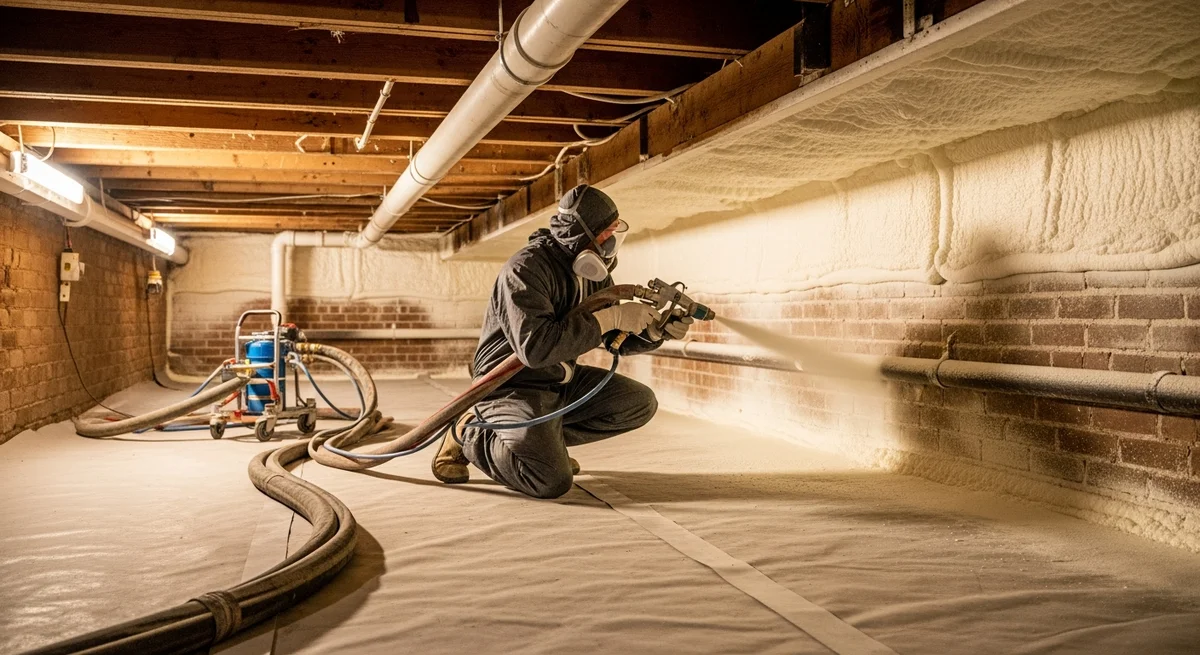
When a Montgomery County contractor proposes spray foam in a crawl space, the work usually covers a few specific zones rather than the entire underside of the house. The rim joist, that band of framing where the floor meets the foundation, is almost always the first target because it is the single biggest source of air leakage in a typical Bethesda colonial or Rockville split-level. The foundation walls themselves come next, especially when the homeowner is encapsulating the space and converting it from vented to conditioned. The subfloor, meaning the underside of the floor above the crawl space, is sometimes foamed when keeping the crawl space vented makes more sense for the property.
In our experience across the Maryland suburbs, the highest-value combination is rim joists plus foundation walls, paired with a sealed vapor barrier on the floor. That is the package most homeowners in Potomac, Chevy Chase, and the older Bethesda neighborhoods end up choosing because it solves the whole list of complaints in a single project rather than chasing one symptom at a time.
Real Cost Ranges Across Montgomery County
The numbers below reflect what homeowners in Bethesda, Rockville, Potomac, and Silver Spring are actually paying in 2026 for closed-cell spray foam at appropriate thicknesses. Open-cell foam costs about 30 to 40 percent less per board foot, but it is rarely the right product down there, so we have not built it into the table.
| Crawl Space Size | Square Footage | Rim Joists Only | Rim Joists + Walls |
|---|---|---|---|
| Small | Under 600 sq ft | $1,200 to $1,800 | $2,800 to $4,200 |
| Typical Bethesda colonial | 600 to 1,000 sq ft | $1,800 to $2,500 | $3,800 to $6,200 |
| Larger Rockville rambler | 1,000 to 1,400 sq ft | $2,500 to $3,500 | $5,500 to $7,800 |
| Potomac estate | 1,400 to 2,000 sq ft | $3,500 to $5,000 | $7,500 to $10,500 |
Adding a full vapor-barrier encapsulation underneath those numbers usually adds another $2,000 to $4,500 depending on square footage, vent count, and whether the floor needs to be regraded before the liner goes down. Most of our Silver Spring and Kensington customers bundle the two so they only pay one mobilization fee and end up with a complete crawl space rather than a half measure.
For the underlying material science behind those numbers, our guide to spray foam R-value, thickness, and fire ratings walks through how thickness affects total cost and performance.
What Actually Drives the Bid Up or Down
When two contractors quote the same Bethesda crawl space and one comes back at $4,200 while the other lands at $7,800, the difference almost always comes down to a handful of specific variables. Knowing what they are lets you compare quotes apples to apples and ask the right questions when something looks off.
Access and Clearance
A crawl space with an exterior door and a four-foot clearance is a comfortable place to work, and the labor cost reflects that. A Rockville rambler with a 22 inch clearance accessed through an interior closet hatch is a different job entirely. Crews move slower, hose runs are longer, equipment cannot be staged efficiently, and the overall bid usually carries a 15 to 25 percent access premium. This is where the post-1970 Bethesda colonial and the older Chevy Chase Cape Cod start to diverge sharply on price.
Moisture Conditions
Standing water, active foundation seepage, or saturated subsoil have to be addressed before any foam goes down. In Potomac and the lower-elevation parts of Silver Spring, we frequently see crawl spaces that need a French drain, a sump pit, or perimeter sealing before insulation work can start. That can add anywhere from $1,500 to $5,000 depending on what is going on, and it is non-negotiable. Foam over wet substrate fails, and a contractor who skips that step is selling you a problem in two years.
Existing Insulation Removal
Most Montgomery County homes built between 1955 and 1985 still have the original fiberglass batts stapled to the underside of the floor. By the time we see them, those batts are usually sagging, partially detached, contaminated by rodent activity, or visibly moldy. Removal and disposal typically runs $500 to $1,800 for a typical Bethesda or Rockville crawl space. Skipping the removal saves money up front but traps the existing problem behind a layer of new foam, and that almost always backfires.
Scope of Foam Coverage
Rim joists alone is one project. Rim joists plus foundation walls is a different project. Rim joists, walls, and the underside of the subfloor is yet another. The square footage of foam applied is the single largest line item on the bid, so understanding exactly which surfaces are getting sprayed lets you make a real apples-to-apples comparison between contractors.
Foam Thickness
Two inches of closed-cell foam delivers about R-14 and meets Maryland code for crawl space wall insulation in our climate zone. Three inches gets you R-21 and noticeably better thermal and acoustic performance. Three inches costs roughly 35 to 45 percent more per square foot of coverage, so the right answer depends on whether you are insulation-focused or whether you are also chasing structural rigidity and sound dampening.
How Pricing Differs Across the Maryland Suburbs
Within Montgomery County, the per-square-foot rate is roughly consistent, but a few neighborhood patterns are worth knowing about because they change which scope makes sense.
Bethesda
Bethesda housing stock is a mix of older brick colonials, mid-century Cape Cods, and the post-2000 teardown rebuilds. The older homes typically have shallow crawl spaces with poor access, while the rebuilds have generous clearance and easy entry. We see the highest variance in Bethesda quotes because of that range, anywhere from $3,200 for a tight 700 square foot crawl in a 1948 Cape to $9,800 for a fully encapsulated 1,800 square foot space under a recent custom build. Learn more about our Bethesda spray foam services.
Rockville
Rockville is dominated by 1960s and 1970s ramblers and split-levels, most with vented crawl spaces of 800 to 1,200 square feet and reasonable clearance. The typical project here is rim joists, walls, and a sealed encapsulation, and the typical price lands between $5,500 and $7,500 all in. See our Rockville spray foam options for more detail.
Potomac
Potomac homes tend to be larger and more recent, often with full basements rather than crawl spaces. When there is a crawl space, it is usually a partial under an addition, and pricing tracks the small to typical column in our table above. Our Potomac service area page covers the full menu of insulation work we do in that area.
Silver Spring
Silver Spring is one of the more humid pockets of the Maryland suburbs because of the lower elevation and proximity to Sligo and Rock Creek watersheds. We almost always recommend full encapsulation here rather than a partial scope, because the moisture loading is just too high for half measures. Expect to land in the $5,500 to $8,500 range for a typical 900 square foot Silver Spring crawl.
Chevy Chase and Kensington
These older neighborhoods are full of 1920s through 1940s housing stock with very tight crawl access and frequent moisture issues. Projects here usually require remediation work first, and the total bid often runs at the upper end of our table. The good news is the energy savings are dramatic because the starting point is so poor.
Spray Foam Versus Other Crawl Space Fixes
Closed-cell spray foam is not the only way to insulate a crawl space, and there are situations where another approach makes more sense for a Montgomery County homeowner. Here is how the alternatives stack up.
| Approach | Typical Cost (1,000 sq ft) | Best For |
|---|---|---|
| Fiberglass batts under subfloor | $1,200 to $2,000 | Tight budgets, dry vented crawls |
| Rigid foam board on walls | $3,500 to $5,500 | DIY-friendly, dry conditions |
| Closed-cell spray foam | $5,500 to $7,500 | Most Montgomery County homes |
| Spray foam + full encapsulation | $8,500 to $12,000 | Humid sites, finished basements above |
For most Bethesda and Rockville homeowners, the third row is the sweet spot. The first row is tempting on price but tends to fail within five to seven years in our humid summers. The second is workable for a dry, easily accessed crawl but rarely delivers the same air-sealing benefit. The fourth is the right call any time the crawl space is unusually wet or sits below a finished basement family room. Our crawl space mold prevention guide goes deeper on when full encapsulation is worth the upgrade.
What to Expect on Install Day
Most Montgomery County crawl space spray foam projects complete in a single day, sometimes spilling into a half-day morning of cleanup if the access is rough or the space is on the larger end. Here is the rhythm of a typical Bethesda or Rockville job.
In the morning, the crew arrives with a spray rig parked in the driveway and runs hoses through the crawl space access. Drop cloths and plastic sheeting protect the path from the entry point through the house, and the HVAC system is shut off and protected from any chance of overspray. If old fiberglass needs to come out, that happens first, and the bagged debris is staged for haul-away.
Spraying itself takes three to six hours for a typical 800 to 1,200 square foot crawl. The foam is applied in lifts of one to two inches at a time, with a brief curing pause between lifts so the chemistry sets correctly and does not overheat. Installers wear full respirators and protective suits. Most homeowners stay out of the work zone during application and can come back in once the off-gassing has dropped, usually within two to four hours of the last spray pass.
By late afternoon, the foam is fully tack-free and the crew is doing final trim work, sealing penetrations, and walking the homeowner through what got installed. Within 24 hours the foam is fully cured and the crawl space is ready for any follow-on work like a new vapor barrier or a small dehumidifier.
How to Vet a Montgomery County Spray Foam Contractor
Spray foam is unforgiving of bad installation. The chemistry has to mix at the right ratio and temperature, the substrate has to be clean and dry, and the lifts have to be the right thickness. A bad install can off-gas for months, fail to cure, or trap moisture in the framing. Vetting the contractor matters more than vetting the product.
Start with the Maryland Home Improvement Commission license. Every legitimate contractor working in Bethesda, Rockville, or anywhere else in the state has an MHIC number, and you can verify it online in about 30 seconds. Confirm general liability and workers compensation coverage, and ask for current certificates rather than a verbal assurance. Manufacturer training matters too. Brands like BASF, Carlisle, and Demilec require certification before contractors can install their foam under warranty, and that certification is a useful signal that the crew knows what they are doing.
Ask the contractor what the substrate temperature is going to be during install. The right answer in a Maryland crawl space is between 60 and 80 degrees, and a serious contractor will have a thermometer and may pre-condition the space before spraying. Ask which foam product they are using and request the technical data sheet. Ask how they handle ventilation during installation. A vague answer to any of those questions is a red flag.
Get at least three quotes and read them carefully. The cheapest bid is rarely the best value, but the most expensive is not automatically the best either. The right answer is usually a contractor in the middle of the range with strong references from recent local projects you can actually drive past.
Permits, Code, and Maryland Energy Standards
Montgomery County follows the International Energy Conservation Code with state and county amendments. For a stand-alone crawl space insulation upgrade in an existing home, you typically do not need a permit, and most homeowners in Bethesda, Rockville, and Silver Spring complete the project without ever interacting with the Department of Permitting Services.
A permit becomes necessary when the work is part of a larger project. Finishing a basement, adding square footage, or building new triggers an energy code review that the permit process enforces. In those cases, the crawl space wall R-value requirement is R-10 continuous or R-13 cavity for our climate zone, and the inspector will check the assembly before the work is closed in.
Maryland code also requires spray foam to be covered with an approved thermal or ignition barrier in most accessible spaces. Some closed-cell formulations are pre-approved as ignition-barrier-free in unoccupied crawl spaces, and a knowledgeable contractor will know which products qualify and document it for you. This matters at resale time when a buyer's home inspector or appraiser asks the question.
Energy Savings, Comfort, and Resale Value
A properly insulated and encapsulated crawl space typically cuts heating and cooling costs by 15 to 25 percent in a Montgomery County home. The savings are biggest in the older Bethesda and Rockville housing stock where the starting envelope is leakier, and somewhat smaller in newer Potomac builds where the rest of the envelope is already tighter.
Beyond the utility-bill math, the comfort upgrade is what most homeowners actually notice. Cold floor syndrome disappears within a week of installation. Musty smells fade as the air pathway between the crawl and the living space closes. HVAC run times drop, which extends equipment life and reduces noise. The kitchen above a previously vented crawl space stops feeling like a different climate zone than the rest of the first floor.
At resale, a fully encapsulated and foamed crawl space shows up clearly on a home inspection report and tends to be a positive note rather than a flag. Energy-conscious buyers in Bethesda, Chevy Chase, and Potomac specifically look for it, and a documented insulation upgrade with manufacturer warranty paperwork can support a slightly higher list price.
Frequently Asked Questions
How much does crawl space spray foam cost in Bethesda and Rockville?
Most Bethesda and Rockville crawl space spray foam projects run $3,000 to $7,500 once you factor in closed-cell foam on the rim joists and foundation walls. Smaller crawl spaces under 600 square feet often land between $2,500 and $4,000, while larger Potomac and Chevy Chase homes with 1,200 to 1,800 square foot crawl spaces typically come in at $6,000 to $9,500.
Why does Montgomery County crawl space foam cost more than the national average?
Three reasons drive the premium: skilled labor in the Bethesda and Rockville market is more expensive, many homes were built in the 1950s through 1970s with tight 18 to 24 inch crawl space clearances that slow installation, and Maryland code requires a covered thermal or ignition barrier in many situations. Add in real moisture management for our humid summers and the per-square-foot price runs about 10 to 15 percent above the national median.
Is closed-cell or open-cell spray foam better for a Maryland crawl space?
Closed-cell is the right answer for nearly every Bethesda, Potomac, or Silver Spring crawl space. It blocks moisture, adds structural rigidity to the rim joist, and delivers about R-7 per inch. Open-cell foam absorbs water and is not appropriate where ground moisture, foundation seepage, or summer humidity are factors, which describes almost every crawl space in Montgomery County.
Do I need to encapsulate the crawl space before spray foaming?
If your goal is long-term moisture control and energy savings, yes. The standard Montgomery County approach is a 12 or 20 mil vapor barrier on the floor, sealed seams up the foundation walls, sealed crawl space vents, and closed-cell spray foam on the rim joists and walls. Encapsulation alone runs $3,500 to $6,500 in Bethesda and Rockville. Combining it with spray foam in one project usually saves on mobilization fees.
Will spray foam help with the musty smell coming from my Silver Spring crawl space?
In most cases, yes. Musty odors are caused by humid air and microbial activity moving from the crawl space up through the floor system into the living space, a phenomenon called the stack effect. Air sealing the rim joists and foundation walls with closed-cell foam stops that air migration. Combined with a vapor barrier and a small dehumidifier, the smell is usually gone within two to three weeks.
Does Montgomery County require permits for crawl space spray foam?
Like-for-like insulation upgrades typically do not require a permit in Bethesda, Rockville, or Potomac. However, if the work is part of a larger renovation, a basement-finish project, or new construction, the Montgomery County Department of Permitting Services will require an energy code review. Your contractor should know exactly when a permit is needed and pull it on your behalf when it is.
Ready for a Real Quote on Your Montgomery County Crawl Space?
Every crawl space is different, and the only way to know exactly what your project will cost is to have a professional walk it. We provide free in-home crawl space evaluations across Bethesda, Rockville, Potomac, Silver Spring, Chevy Chase, and Kensington. The visit takes about 45 minutes, includes moisture readings and access measurements, and ends with a written quote that breaks down each line item so you can compare it to anything else you have on the table.
Schedule Your Free Crawl Space Evaluation
Bethesda, Rockville, Potomac, Silver Spring & surrounding Maryland suburbs. Free, no-pressure quote.
Book a Free Evaluation